
Starting a Pool Business While Working Full Time: A Realistic Guide


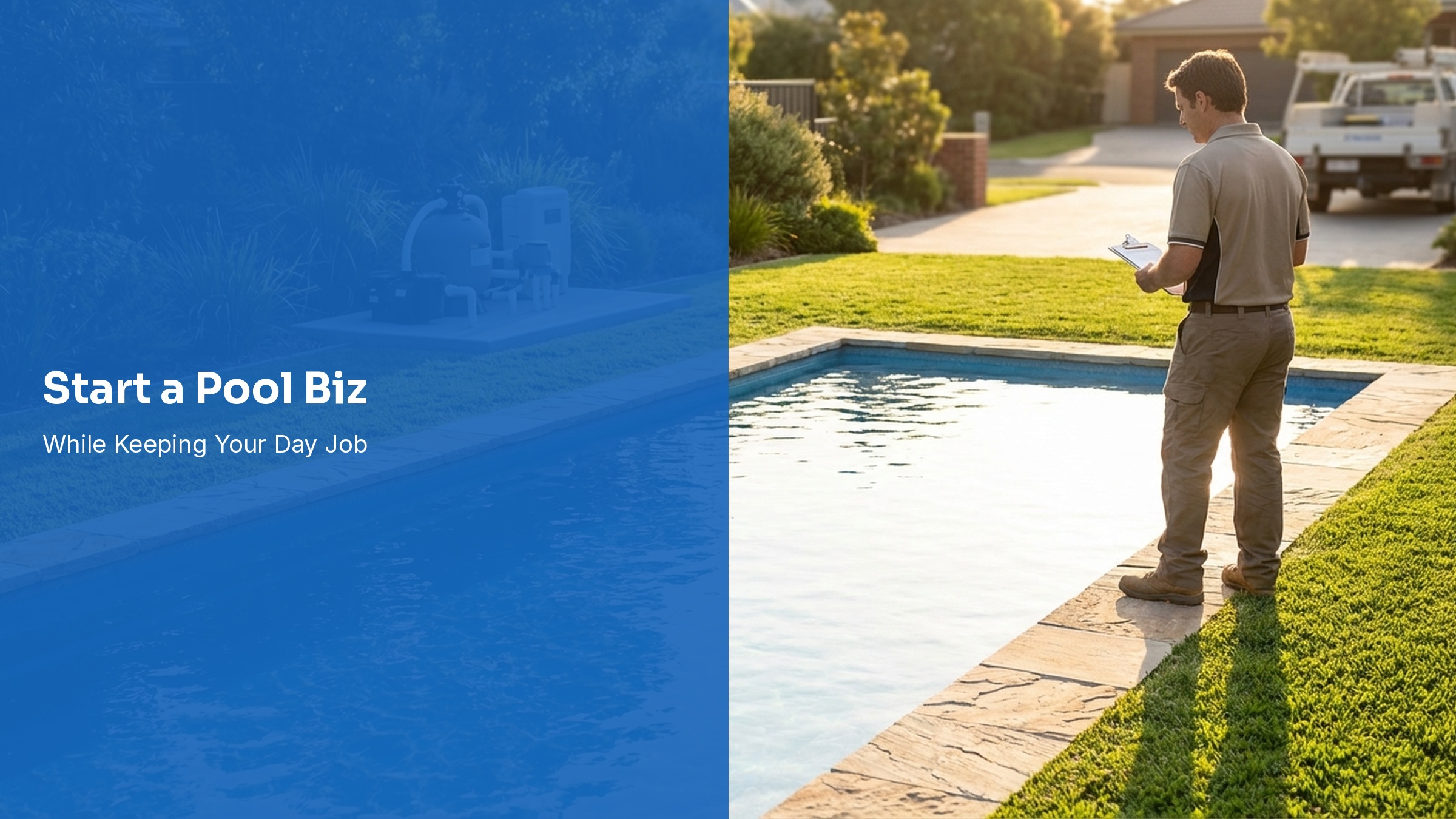
You have a steady job. You also have capital, a truck, and a plan to start cleaning pools. The goal is to build a route on the side and eventually go full time. It is a smart way to reduce risk. But the execution matters a lot.
Pool pros who have done it say the same things over and over. You can absolutely build a route while keeping your day job. But there are real traps that will slow you down or burn you out. This guide covers what actually works.
Key Takeaways
- Do not stack all 20 pools on Saturday. Spread them across weekday evenings instead.
- Weekends are when customers are home and problems are most visible. Plan for interruptions.
- Get supervised field experience before accepting responsibility for customer pools.
- Treat your first customers like gold. Referrals are your fastest growth path when time is short.
- If you currently work for a pool company, be upfront before going out on your own.
- Use software to handle scheduling and invoicing so your limited hours go toward actual pool work.
Learn the Work Before You Own the Risk
Keeping your current job can reduce financial risk, but it does not reduce your duty of care at a customer's property. A recent PoolPros discussion started with a new entrant who had studied chemistry online but had no hands-on experience. The strongest replies focused on field judgment, not memorizing target ranges.
"You absolutely need to work in the field full time before diving into it. This isn't a side gig and people don't want to train someone who is just going to leave."
— Pool pro via Reddit
Full-time employment is not the only possible learning path, but supervised repetition matters. A ride-along, seasonal helper role, apprenticeship, manufacturer training, or properly scoped employee position can expose you to equipment failures, unsafe electrical conditions, leaks, surface problems, and customer communication before you are the person financially responsible for the result.
"Highly recommend working with a company. The jobs not rocket science per se, but there are many little nuances that you pick up on with time. Get the hands on experience."
— Pool pro via Reddit
Certification can provide a useful foundation, but an exam does not replace field training. Before taking a paying account, verify the licensing, insurance, tax, chemical-transport, and local public-health requirements that apply to your work. Define what you will not do, build relationships with qualified repair specialists, and carry coverage appropriate to the property and services in your care.
A practical readiness test is simple: can you recognize when a pool is unsafe, stop work, secure the site, explain the issue, and bring in the right specialist? If the answer is no, continue training before advertising independent weekly service.
The Saturday-Only Trap
The most common mistake is trying to do everything on one day. It sounds simple: clean all 20 pools on Saturday, collect the money, and keep your weekday job. But pool work does not always cooperate.
"It can be done, but 20 pools in a day to start is spreading yourself thin. Have you considered repairs, problems, green pools that you will encounter and that take extra time? Weekends are when folks are most likely to be home relaxing, by the pool!"
— Pool pro via Reddit
Think about what actually happens on a Saturday route. One pool has a green water problem that takes 45 extra minutes. Two homeowners want to chat. A pump is making a noise and the customer wants an answer now. You are three hours behind by noon.
Green pools alone can wreck a full-day schedule. Algae treatments require return visits. Filters need backwashing. Skimmer baskets overflow after a storm. When you are already running late, a single problem pool spirals into a very long day.
Then there is the weather issue.
"What happens if it rains on Saturday or Sunday? It's OK with a few pools but not 20."
— Pool pro via Reddit
Rain does not cancel pool service, but lightning does. If you lose your one service day to a thunderstorm, every customer on that route goes unserviced. That is a problem when you only have one day to work with.
There is also a deeper issue. Building a serious business as a weekend side project sends a message to customers that this is not your main thing. That perception affects whether they refer you, trust you with repairs, or stick around long-term.
"You're setting a business up for failure by making it a second priority."
— Pool pro via Reddit
That does not mean you cannot do it. It means you need a smarter approach than Saturday-only service.
A Better Approach: Spread Pools Across Weekday Evenings
The fix is simple. Do not do 20 pools on Saturday. Do 4 pools on Monday evening, 4 on Tuesday, and so on. You finish the same number of pools in a week but never face a catastrophic single-day failure.
"Spread those pools out during the week if you are still working. It is easier to do 20 pools over 5 days, 30 minutes a pop solo you will be done your extra work probably in 2-3 hrs per day."
— Pool pro via Reddit
Two to three hours per evening is manageable. You get home from your day job at 5 pm. You are on your first pool by 5:30. You finish your four stops by 7:30 or 8. You eat dinner and get to bed at a reasonable hour.
This approach also builds in flexibility. If a pool takes longer than expected, you have the rest of the evening. If you need to skip a day, you have the rest of the week to redistribute.
Use the Route Capacity Planner to see how many stops you can realistically fit in per day given drive time, stop time, and your available hours. Route density matters a lot here. The tighter your route geography, the more pools you can fit into a short evening window.
For the math on what each pool needs to earn you, run the Cost Per Pool Calculator. Knowing your break-even number helps you set prices correctly from the start.
If You Work for a Pool Company, Be Upfront
A lot of people who start a pool side business are already working for a pool company during the week. If that is you, there is an important step to take before you get your first customer.
"For starters, if you work for a pool company during the week, I would highly recommend stop working for them and explain your plans to go out on your own. You will piss off your old boss if you are not up front with him."
— Pool pro via Reddit
This matters for several reasons. First, your employer may have a non-compete clause in your contract. Servicing pools in the same area while on their payroll is a legal risk. Second, the pool industry is small. Reputations travel fast. Getting caught poaching customers or starting a competing route in secret will follow you.
Being honest is also just good business. Your boss may respect the move. Some employers will even refer you overflowing work once you go independent. Others will let you buy a small starter route when you leave.
If you work in a different industry entirely and pool service is a brand-new venture, this section does not apply to you. But if there is any overlap between your current employer and the business you are starting, a direct conversation protects you both legally and professionally.
Equipment and Systems to Save Time
When you have two or three hours per evening, every minute counts. The right gear and tools keep you moving.
Telescopic pole and net combo. A good pole with a quick-change connection lets you swap between net, brush, and vacuum head without stopping. Cheap equipment slows you down at every stop.
Taylor K-2006 test kit. The Taylor kit is the industry standard for accurate water chemistry readings. Strips are faster but less reliable. When you are building a reputation on clean water, accuracy matters more than speed.
Pump cart or hand truck. Moving chemical buckets and equipment bag from truck to pool and back again adds up. A small cart saves your back and your time.
Pool service software. This is the biggest time saver you will find. PoolDial handles scheduling, route optimization, invoicing, and chemical log tracking. You should not be spending your limited evening hours entering data or sending invoices by hand. Software automates the office work so your hours go toward actual pool care.
Use the Service Price Calculator to set rates that cover your costs and your time. Underpricing early accounts is a trap that is hard to undo later.
Growing Through Referrals When You Have No Marketing Time
You cannot run Google Ads, knock on doors, and attend networking events when you are working a full-time job. Your growth engine has to be referrals.
"The highest leverage way to do this is to treat your first 20 customers like GOLD. Make them RAVE about their experience with you and win referral business. You don't have a ton of time, so you want route density, which means your current customers telling their neighbors about you."
— Pool pro via Reddit
Route density means your customers are clustered in the same neighborhoods. When a happy customer tells their neighbor about you, that neighbor is already on your route path. Adding them costs almost no extra drive time.
Here is how to build a referral machine with limited time:
- Send a chemical report after every visit. A brief message showing what you tested and what you adjusted builds trust. Customers who see the work you do behind the scenes are more likely to refer you.
- Fix small things without billing for them. Adjust a loose fitting, clear a clogged basket, clean a dirty pump lid. These small gestures are what customers talk about.
- Ask directly. After the first month, tell your best customers that you are growing your route and ask if they know any neighbors who might be interested. Most people are happy to refer someone they trust.
- Leave a card at the equipment pad. Visitors, contractors, and future homeowners will see it.
Read the full guide on how to start a pool service business for a broader look at customer acquisition strategies and what to expect in year one.
When to Make the Leap to Full Time
The whole point of the side-hustle approach is to build enough of a route that quitting your day job feels safe, not reckless. But how do you know when you are ready?
The clearest signal is income replacement. Most financial advisors suggest your side income should match or exceed your current take-home pay for at least three months before you quit. That cushion covers unexpected slow months and startup expenses you have not hit yet.
One pool pro described a common two-year path:
"I've been building mine for 2 years now. I'm up to 15 pools thru ads and word of mouth. I'm getting ready to get a loan and buy another 10-20 pools and go self employed. I've been working a full time job for a big pool service company."
— Pool pro via Reddit
Fifteen organic pools after two years of part-time effort is a real foundation. Buying an additional 10 to 20 pools through an established route purchase means you can go full time with 25 to 35 accounts on day one. That is a viable solo operation in most markets.
Some benchmarks to hit before you quit:
- At least 30 to 40 pools. That range generates $3,000 to $5,000 per month in most markets depending on your price. Run your numbers with the Service Price Calculator to confirm.
- Three months of expenses saved. Truck repairs, equipment failures, and slow seasons happen. A cash buffer keeps you from panicking.
- Established billing and scheduling systems. Going full time means adding more pools fast. If your admin process is manual and messy, growth will overwhelm you.
- A repair referral network. You do not need to do every repair yourself, but you need someone to call. Build those relationships before you go full time.
The transition does not have to be all at once. Some pros negotiate part-time or flexible hours at their day job first. That gives more time for the pool route without full income loss.
Automate the Office Work So You Can Focus on Pools
PoolDial handles scheduling, route optimization, invoicing, and chemical logs. When your hours are limited, let software handle the admin so every minute goes toward growing your route.
Start Free TrialThe Bottom Line
Building a pool route while keeping a full-time job is one of the lowest-risk ways to start a service business. You keep your income while you build. You learn the trade before betting everything on it.
But it only works if you treat the pool business like a real business from day one. That means spreading your pools across the week instead of cramming them into one day, being upfront if you work for a competitor, obsessing over your first customers so referrals do the marketing for you, and using tools that make the most of your limited time.
The goal is to get to a place where quitting your day job feels like an upgrade, not a leap of faith. Two years of focused part-time effort can get you there.